Saturday, February 18, 2006

Gmail accounts

Hi,

I know that some of you mught not have a gmail account. Please mail me at rodmig@gmail.com and I will sent you an invitation.

Technorati Tags:

Thursday, February 16, 2006

Free T-shirt

I have just won a t-shirt from Google, from Bernardo Hernández Google Marketing Director in Spain, who was in our IMBA S4 class to make a brieft presentation on Google.

The question was: "How many Gmail users are there in the world?", and my answer was 50 million. It was right. I tryed to search the answer on Google, but it was not displaying on the first page so I tried the 50 million.... it was right.

Lucky day.

Technorati Tags:

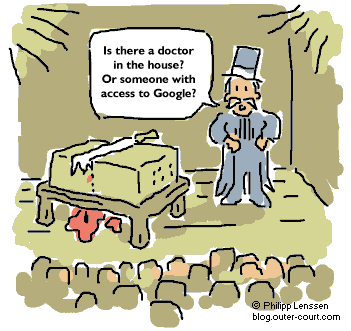
Google Cartoon


"Google in cartoons"

Google want to be the answer of all our questions.

I got this cartoon from Blog Outer-Court

Technorati Tags: Google Cartoon

Google vs. Yahoo

Some quick numbers on the financials of Google and Yahoo!

Sales (USD M) Market Cap Net income (USD M) Net Profit Margin
Google 6,138 101, 467 1,465 23,87%
Yahoo 5,257 46,421 1,896 33,77%

It interesting to see how Google has 29% less Net income than Yahoo and Google's market cap is 1,18 times bigger.

Definately investors are expecting and demanding higher growth rates from Google. Yahoo which was in the past the e-star, seems to be now lagging behing Google. Yahoo's Net Profit Margin is the highest among the comparable companies. So while Yahoo is still a good business, and Google is setting high expectations but yet it is to soon to judge. The truth is that they are constantly bring news to the market...

I would like to further explain the difference in the market caps. I am doing some research and posting it later

Source: Factiva.

Technorati Tags: yahoo google

Wednesday, February 15, 2006

some info on my country - BELARUS

Hi guys,
I was going through the reading on google for our IT assignment and decided to check the blogs that exist with any info on my country (usually even internet websites are conotrolled by the Belarusian government against freedom of expression). and.... wow... I found that blogging could be on of the best tools for discussing the intolerable situation with human rights and dignity in Belarus. Anyway.. to cut the story short I found a blog of this guy http://freddies-world.blogspot.com/ who posted an article which can be quite informative for you. Besides he is descirbing couple of other Eastern European capitals, e.g. Budapest, Bratislava, Bucharest, Belgrade etc. (all of them start with B:-)). I hope you find it enjoyable.

Monday, February 13, 2006

The power of weblogs

The growing power of Weblogs, or "blogs," has hardly gone unnoticed. Bloggers have been credited with helping to topple Trent Lott and Howell Raines, with inflaming debate over the Iraq war, and with boosting presidential hopeful Howard Dean. Suddenly, it seems, everyone from Barbra Streisand (whose site is a lefty clearinghouse) to guy-next-door Bruce Cole (a San Francisco foodie whose blog is called Sauté Wednesday), has been swept into the blogosphere. But blogs aren't as new as you may think. They have actually been around since the early days of the Internet. In the strictest sense, a blog is someone's online record of the Web sites he or she visits.
Today's blogs, of course, are much more than that. In 1999 there were dozens of blogs. Now there are millions. What happened?
Simply put, some of the blogging pioneers — in aneffort to make their own work easier — built tools that allow anyone, no matter how little Internet savvy he or she possesses, to create and maintain a blog. All you need to get started is a name, a password, and an e-mail address. The most popular of these tools is the aptly named Blogger.com, which was launched in August 1999 by Evan Williams, Paul Bausch, and Meg Hourihan and quickly became the largest and best-known of its kind. Part of Blogger.com's appeal is that it lets people store blogs on their own servers, rather than on a remote base. This allows them to have a personalized address (like www.yourname.com), whereas with other blogging tools your address starts at the remote server.
Blogger.com — which was recently snatched up by Google from the owner, Pyra Labs, for an undisclosed sum — may be the biggest, but it wasn't the first. That honor goes to Andrew Smales, a programmer in Toronto who launched the first do-it-yourself blog tool — Pitas.com — in July 1999. Smales, twenty-nine, sort of blundered into blogging as he was developing software that would allow him to more easily update his personal Web site and also facilitate the "online diary community" he envisioned. Personal sites such as his aren't listed prominently on Internet search engines, and Smales thought it would be "cool if I could just click around to read what other people were saying," rather than surf blindly for their sites. As Smales worked on the software, he posted updates on his site, prompting visitors to offer suggestions. It was a comment from a visitor that clued Smales into the nascent blogging community, and he set to work on a sister project to the diary software — a blogging tool that would become Pitas. Diaryland, Smales's diary site, followed soon thereafter, and both have grown steadily since.
Smales says the explosion of blog tools was simply a matter of critical mass. "There were finally enough people online writing blogs and wanting to read them" that someone was bound to find a way to ease the process. In fact, he notes, the technology behind these tools was neither new nor terribly sophisticated. His own reason for starting the project offers another explanation: people like to peek into others' lives. Reading a blog has a bit of the voyeuristic thrill of flipping through someone's journal, no matter how mundane the content. Today's blogs have evolved well beyond the lists of links that characterized early efforts. They are diaries and soapboxes, where people can post everything from daily minutiae to manifestoes to sophisticated political and cultural commentary and reporting. The evolution of Diaryland and Pitas exemplifies this, because while Smales originally had different aims for each, their content is now indistinguishable. So if his dream for an online diary community has not been fully realized, it certainly has been adopted in spirit.

Is it possible to build a blogging empire - one weblog at a time?

Jason McCabe Calacanis (personal blog), Chairman of The Weblogs, Inc. thinks that it's a funny way of putting it.read more at: http://weblogs.about.com/od/usesandrolesofblogs/a/jasoncalacanis.htm

Can we make money out of weblogs? Is this another bubble?

Technorati Tags:

Can we make money out of weblogs? Is this another bubble?

Well, to be honest coming from Egypt where the internet penetration is really lagging behind Europe and the States, blogging is not common. From all my friends back home I only know 2 people that are bloggers. Internet and its applications to IT and the rest of the business world in Egypt are still evolving. However, the awareness of the great potential the internet has for the consumer, customer, businessman or government is increasing by the minute. That is driving people to be more and more creative in how they do business. For instance, Durex condoms is a fairly recent supplier of condoms in Egypt, to accelerate the process of promoting their products, they post their adds not on Tv or news papers but on MSN messenger in Egypt. Therefore, targeting specific age groups, social levels, educational level, etc. I won’t be surprised that more of these companies will soon target advertising through blogs. Accordingly bloggers will be finding different ways of making money very soon.

Some ways of making money from blogs as I read through the internet included but not limited to the following;
Ads of products and services offered by individuals and companies. For instance “Google Adsense” and “Chitika”.
Merchandising products
Link to affiliate programs or other websites
Books
Offer restaurant critiques for instance. (even maybe extending it to other product reviews)
Promoting yourself and your expertise, (you can be called to deliver professional presentations, seminars or even start writing your own book all providing different sources of income).
To become a professional blog writer hired by companies or blog owners.


The key points to consider when trying to develop a blog to make money are; identifying your niche (and target audience), attract consistent traffic and continue adding valuable and quality content to your blog. Of course the right metrics and statistics have to be developed and used for decision making.

Can this be another bubble?...Well, I cant really tell. My gut feeling tell me yes it is a potential bubble. However, that does not mean you can’t make money till the bubble bursts.

Sunday, February 12, 2006

IE IMBA2006 S4 Group G

IE IMBA2006 S4 Group G

Chicos,now something about J.Calacanis using Wiki,the most objective source of info avaiable on the Net:

Jason Calacanis is a blogger and internet entrepreneur. He and Brian Alvey are co-founders of Weblogs Inc., which has been one of the most visible attempts to turn blogging into a viable advertising-based business model.


One of his best-known actions took place in March 2004, when he hired Peter Rojas away from his Gawker.com job as the blogger and co-founder of Gizmodo, and partnered with him on a rival blog, Engadget. Calacanis and Nick Denton are frequently portrayed as rivals.
Calacanis was the founder of Silicon Alley Reporter and Digital Coast Reporter magazines. SAR, as it was referred to, grew from a photocopied newsletter to a 300 page glossy magazine with a staff of 70 employees, and launched the careers of many famous writers like Clay Shirky, Tristan Louis, Rafat Ali of PaidContent.org, and Xeni Jardin. The magazine, however, was hit hard by the dotcom implosion and in September of 2001 Calacanis changed the name to Venture Reporter. VentureReporter.net was sold to Dow Jones corporation.
Calacanis was also profiled in the New Yorker and Wired magazine during the dotcom boom. The profile from the New Yorker was titled "the connector" and was the basis for Malcolm Gladwell's "connectors" described in the book "The Tipping Point." Calacanis was featured on the cover of Forbes along with Rojas and BoingBoing's Xeni Jardin (who worked for Calacanis' Silicon Alley Reporter before moving on to Boingboing, Wired and NPR). His rolodex includes heavy hitters like Mark Cuban (an investor in Weblogs, Inc.), Charlie Rose, and Jeff Bezos.
Calacanis was profiled in Wired a second time (issue 14.01) for his work on commercializing blogging.
Calacanis is known for being outspoken and moderately transparent about Weblogs, Inc., going so far as to give updates on the company's Google Adsense earnings. Time Warner's America Online agreed to buy Weblogs, Inc. in October 2005 for a reported $20 to $40 million--the amount was never officially disclosed.
Calacanis was a consultant on, and appeared in, The Center of the World, a film by Wayne Wang with Peter Saarsgard

IE IMBA2006 S4 Group G

IE IMBA2006 S4 Group G

Hola chicos,i am gonna post something related to the history of weblogs;i am pretty sure will help u with the assignment for tomorrow;

In 1998 there were just a handful of sites of the type that are now identified as weblogs (so named by Jorn Barger in December 1997). Jesse James Garrett, editor of Infosift, began compiling a list of "other sites like his" as he found them in his travels around the web. In November of that year, he sent that list to Cameron Barrett. Cameron published the list on Camworld, and others maintaining similar sites began sending their URLs to him for inclusion on the list. Jesse's 'page of only weblogs' lists the 23 known to be in existence at the beginning of 1999.

Suddenly a community sprang up. It was easy to read all of the weblogs on Cameron's list, and most interested people did. Peter Merholz announced in early 1999 that he was going to pronounce it 'wee-blog' and inevitably this was shortened to 'blog' with the weblog editor referred to as a 'blogger.'

At this point, the bandwagon jumping began. More and more people began publishing their own weblogs. I began mine in April of 1999. Suddenly it became difficult to read every weblog every day, or even to keep track of all the new ones that were appearing. Cameron's list grew so large that he began including only weblogs he actually followed himself. Other webloggers did the same. In early 1999 Brigitte Eaton compiled a list of every weblog she knew about and created the Eatonweb Portal. Brig evaluated all submissions by a simple criterion: that the site consist of dated entries. Webloggers debated what was and what was not a weblog, but since the Eatonweb Portal was the most complete listing of weblogs available, Brig's inclusive definition prevailed.

This rapid growth continued steadily until July 1999 when Pitas, the first free build-your-own-weblog tool launched, and suddenly there were hundreds. In August, Pyra released Blogger, and Groksoup launched, and with the ease that these web-based tools provided, the bandwagon-jumping turned into an explosion. Late in 1999 software developer Dave Winer introduced Edit This Page, and Jeff A. Campbell launched Velocinews. All of these services are free, and all of them are designed to enable individuals to publish their own weblogs quickly and easily.

The original weblogs were link-driven sites. Each was a mixture in unique proportions of links, commentary, and personal thoughts and essays. Weblogs could only be created by people who already knew how to make a website. A weblog editor had either taught herself to code HTML for fun, or, after working all day creating commercial websites, spent several off-work hours every day surfing the web and posting to her site. These were web enthusiasts.

Many current weblogs follow this original style. Their editors present links both to little-known corners of the web and to current news articles they feel are worthy of note. Such links are nearly always accompanied by the editor's commentary. An editor with some expertise in a field might demonstrate the accuracy or inaccuracy of a highlighted article or certain facts therein; provide additional facts he feels are pertinent to the issue at hand; or simply add an opinion or differing viewpoint from the one in the piece he has linked. Typically this commentary is characterized by an irreverent, sometimes sarcastic tone. More skillful editors manage to convey all of these things in the sentence or two with which they introduce the link (making them, as Halcyon pointed out to me, pioneers in the art and craft of microcontent). Indeed, the format of the typical weblog, providing only a very short space in which to write an entry, encourages pithiness on the part of the writer; longer commentary is often given its own space as a separate essay.

These weblogs provide a valuable filtering function for their readers. The web has been, in effect, pre-surfed for them. Out of the myriad web pages slung through cyberspace, weblog editors pick out the most mind-boggling, the most stupid, the most compelling.

But this type of weblog is important for another reason, I think. In Douglas Rushkoff's Media Virus, Greg Ruggerio of the Immediast Underground is quoted as saying, "Media is a corporate possession...You cannot participate in the media. Bringing that into the foreground is the first step. The second step is to define the difference between public and audience. An audience is passive; a public is participatory. We need a definition of media that is public in its orientation."

By highlighting articles that may easily be passed over by the typical web user too busy to do more than scan corporate news sites, by searching out articles from lesser-known sources, and by providing additional facts, alternative views, and thoughtful commentary, weblog editors participate in the dissemination and interpretation of the news that is fed to us every day. Their sarcasm and fearless commentary reminds us to question the vested interests of our sources of information and the expertise of individual reporters as they file news stories about subjects they may not fully understand.

Weblog editors sometimes contextualize an article by juxtaposing it with an article on a related subject; each article, considered in the light of the other, may take on additional meaning, or even draw the reader to conclusions contrary to the implicit aim of each. It would be too much to call this type of weblog "independent media," but clearly their editors, engaged in seeking out and evaluating the "facts" that are presented to us each day, resemble the public that Ruggerio speaks of. By writing a few lines each day, weblog editors begin to redefine media as a public, participatory endeavor.

Now, during 1999 something else happened, and I believe it has to do with the introduction of Blogger itself.

While weblogs had always included a mix of links, commentary, and personal notes, in the post-Blogger explosion increasing numbers of weblogs eschewed this focus on the web-at-large in favor of a sort of short-form journal. These blogs, often updated several times a day, were instead a record of the blogger's thoughts: something noticed on the way to work, notes about the weekend, a quick reflection on some subject or another. Links took the reader to the site of another blogger with whom the first was having a public conversation or had met the previous evening, or to the site of a band he had seen the night before. Full-blown conversations were carried on between three or five blogs, each referencing the other in their agreement or rebuttal of the other's positions. Cults of personality sprung up as new blogs appeared, certain names appearing over and over in daily entries or listed in the obligatory sidebar of "other weblogs" (a holdover from Cam's original list). It was, and is, fascinating to see new bloggers position themselves in this community, referencing and reacting to those blogs they read most, their sidebar an affirmation of the tribe to which they wish to belong.

Why the change? Why so many? I have always suspected that some of the popularity of this form may be a simple desire to emulate the sites of head Pyra kids Ev and Meg. As the creators of Blogger, their charming, witty blogs are their company's foremost advertisement for its most popular product.

More than that, Blogger itself places no restrictions on the form of content being posted. Its web interface, accessible from any browser, consists of an empty form box into which the blogger can type...anything: a passing thought, an extended essay, or a childhood recollection. With a click, Blogger will post the...whatever...on the writer's website, archive it in the proper place, and present the writer with another empty box, just waiting to be filled.

Contrast this with the web interface of Metafilter, a popular community weblog. Here, the writer is presented with three form boxes: the first for the URL of the referenced site, the second for the title of the entry, and the third for whatever commentary the writer would like to add. The Metafilter interface instructs the writer to contribute a link and add commentary; Blogger makes no such demands. Blogger makes it so easy to type in a thought or reaction that many people are disinclined to hunt up a link and compose some text around it.

It is this free-form interface combined with absolute ease of use which has, in my opinion, done more to impel the shift from the filter-style weblog to journal-style blog than any other factor. And there has been a shift. Searching for a filter-style weblog by clicking through the thousands of weblogs listed at weblogs.com, the Eatonweb Portal, or Blogger Directory can be a Sisyphean task. Newcomers would appear to be most drawn to the blog rather than filter style of weblogging.

Certainly, both styles still exist; certainly the particular mixture of links, commentary, and personal observation unique to each individual site has always given each weblog its distinctive voice and personality; and certainly the weblog has always been an infinitely malleable format. But the influx of blogs has changed the definition of weblog from "a list of links with commentary and personal asides" to "a website that is updated frequently, with new material posted at the top of the page." I really wish there were another term to describe the filter-style weblog, one that would easily distinguish it from the blog. On the principle of truth in advertising, this would make it much easier for the adventuresome reader to find the type of weblog he most enjoys.

So, what of the weblog? Is it of interest or importance to anyone who does not produce one? Well, I think it should be.

A filter-style weblog provides many advantages to its readers. It reveals glimpses of an unimagined web to those who have no time to surf. An intelligent human being filters through the mass of information packaged daily for our consumption and picks out the interesting, the important, the overlooked, and the unexpected. This human being may provide additional information to that which corporate media provides, expose the fallacy of an argument, perhaps reveal an inaccurate detail. Because the weblog editor can comment freely on what she finds, one week of reading will reveal to you her personal biases, making her a predictable source. This further enables us to turn a critical eye to both the information and comments she provides. Her irreverent attitude challenges the veracity of the "facts" presented each day by authorities.

Shortly after I began producing Rebecca's Pocket I noticed two side effects I had not expected. First, I discovered my own interests. I thought I knew what I was interested in, but after linking stories for a few months I could see that I was much more interested in science, archaeology, and issues of injustice than I had realized. More importantly, I began to value more highly my own point of view. In composing my link text every day I carefully considered my own opinions and ideas, and I began to feel that my perspective was unique and important.

This profound experience may be most purely realized in the blog-style weblog. Lacking a focus on the outside world, the blogger is compelled to share his world with whomever is reading. He may engage other bloggers in conversation about the interests they share. He may reflect on a book he is reading, or the behavior of someone on the bus. He might describe a flower that he saw growing between the cracks of a sidewalk on his way to work. Or he may simply jot notes about his life: what work is like, what he had for dinner, what he thought of a recent movie. These fragments, pieced together over months, can provide an unexpectedly intimate view of what it is to be a particular individual in a particular place at a particular time.

The blogger, by virtue of simply writing down whatever is on his mind, will be confronted with his own thoughts and opinions. Blogging every day, he will become a more confident writer. A community of 100 or 20 or 3 people may spring up around the public record of his thoughts. Being met with friendly voices, he may gain more confidence in his view of the world; he may begin to experiment with longer forms of writing, to play with haiku, or to begin a creative project--one that he would have dismissed as being inconsequential or doubted he could complete only a few months before.

As he enunciates his opinions daily, this new awareness of his inner life may develop into a trust in his own perspective. His own reactions--to a poem, to other people, and, yes, to the media--will carry more weight with him. Accustomed to expressing his thoughts on his website, he will be able to more fully articulate his opinions to himself and others. He will become impatient with waiting to see what others think before he decides, and will begin to act in accordance with his inner voice instead. Ideally, he will become less reflexive and more reflective, and find his own opinions and ideas worthy of serious consideration.

His readers will remember an incident from their own childhood when the blogger relates a memory. They might look more closely at the other riders on the train after the blogger describes his impressions of a fellow commuter. They will click back and forth between blogs and analyze each blogger's point of view in a multi-blog conversation, and form their own conclusions on the matter at hand. Reading the views of other ordinary people, they will readily question and evaluate what is being said. Doing this, they may begin a similar journey of self-discovery and intellectual self-reliance.

The promise of the web was that everyone could publish, that a thousand voices could flourish, communicate, connect. The truth was that only those people who knew how to code a web page could make their voices heard. Blogger, Pitas, and all the rest have given people with little or no knowledge of HTML the ability to publish on the web: to pontificate, remember, dream, and argue in public, as easily as they send an instant message. We can't seriously compare the creation of the World Wide Web itself with the availability of free technology that allows anyone with a web browser to express their unique, irreproducible vision to the rest of the world...can we?

In September of 2000 there are thousands of weblogs: topic-oriented weblogs, alternative viewpoints, astute examinations of the human condition as reflected by mainstream media, short-form journals, links to the weird, and free-form notebooks of ideas. Traditional weblogs perform a valuable filtering service and provide tools for more critical evaluation of the information available on the web. Free-style blogs are nothing less than an outbreak of self-expression. Each is evidence of a staggering shift from an age of carefully controlled information provided by sanctioned authorities (and artists), to an unprecedented opportunity for individual expression on a worldwide scale. Each kind of weblog empowers individuals on many levels.

So why doesn't every bookmark list contain five weblogs? In the beginning of 1999 it really seemed that by now every bookmark list would. There was a bit of media attention and new weblogs were being created every day. It was a small, quick-growing community and it seemed to be on the edge of a wider awareness. Perhaps the tsunami of new weblogs created in the wake of Pitas and Blogger crushed the movement before it could reach critical mass; the sudden exponential growth of the community rendered it unnavigable. Weblogs, once filters of the web, suddenly became so numerous they were as confusing as the web itself. A few more articles appeared touting weblogs as the next big thing. But the average reader, hopefully clicking through to the Eatonweb portal, found herself faced with an alphabetical list of a thousand weblogs. Not knowing where to begin, she quickly retreated back to ABCnews.com.

I don't have an answer. In our age the single page website of an obscure Turk named Mahir can sweep the web in days. But the unassailable truth is that corporate media and commercial and governmental entities own most of the real estate. Dell manages more webpages than all of the weblogs put together. Sprite's PR machine can point more man-hours to the promotion of one message--"Obey Your Thirst"--than the combined man-hours of every weblogger alive. Our strength--that each of us speaks in an individual voice of an individual vision--is, in the high-stakes world of carefully orchestrated messages designed to distract and manipulate, a liability. We are, very simply, outnumbered.

And what, really, will change if we get weblogs into every bookmark list? As we are increasingly bombarded with information from our computers, handhelds, in-store kiosks, and now our clothes, the need for reliable filters will become more pressing. As corporate interests exert tighter and tighter control over information and even art, critical evaluation is more essential than ever. As advertisements creep onto banana peels, attach themselves to paper cup sleeves, and interrupt our ATM transactions, we urgently need to cultivate forms of self-expression in order to counteract our self-defensive numbness and remember what it is to be human.

We are being pummeled by a deluge of data and unless we create time and spaces in which to reflect, we will be left with only our reactions. I strongly believe in the power of weblogs to transform both writers and readers from "audience" to "public" and from "consumer" to "creator." Weblogs are no panacea for the crippling effects of a media-saturated culture, but I believe they are one antidote.


I took this article from the rebecca blood website;this girl is a freelance journalist.....well,this is a wonderful way for freelances to show their skills......

Ciao Bestiacce

Edo

Thursday, February 09, 2006

What has happened between Weblogs Inc. and AOL?.

What is Weblogs?
From the “Supply Side”, I would say that Weblogs is an editorial office producing blogs in specialized, ‘niche’ consumer and trade markets, with over 30 million monthly web page views and 25 million monthly RSS page views per month. Weblogs’ more popular blogs include: Engadget (technology), Autoblog (automotive), Joystiq (gaming), Cinematical (films), Blogging Baby (parenting), Luxist (luxury), Gadling (travel), The Wireless Weblog, SlashFood, and TVSquad.
From the “Demand Side”, I would say that Weblogs is a conglomerate of different communities, each one sharing some needs or interests (by the way, this is the same definition of “Market Segment”; is it a coincidence?, I do not think so).

What happened?
America Online, Inc. acquired Weblogs, Inc for an amount of money equal to 25 Ml US$ in 05/10/2005.

Who bought Weblogs?
America Online, Inc. is a wholly owned subsidiary of Time Warner Inc. and is the world's leader in interactive services, Web brands, Internet technologies and e-commerce services. In the Value Chain of Internet Sector, I would categorize AOL as an ISP, a Content Aggregator (Pure Portal) and a Content Provider.

How?
Simply making an offer to the founder and receiving his approval.

How much?
Approx. 25 Ml. US$.
http://www.webpronews.com/topnews/topnews/wpn-60-20060116GatherWavesAdCashAtBloggers.html

What has been really bought?
Two “objects” have been bought. The first, more than 100 independent, freelance expert bloggers producing over 1,000 blog postings weekly. The second, Internet reading Customers (over 30 million monthly web page views and 25 million monthly RSS page views per month).

Why the purchase?
I would use the S4C Model to analyze AOL.
The S4C Model classifies every Internet venture along five different dimensions of Value Propositions: Service (e.g. free email, ISProviding, loan calculations, diet formulation, …), Commerce (e.g. Internet shop, Internet Mall, Buyers Aggragators, Virtual Market place), Context (e.g. Search engine, …), Content (e.g. Content providing, like corporate site, newspaper site, …), Community (e.g. Ferrari Owners Club, Metallica unofficial fans club).
AOL is the typical 360 degree offer portal because it is well present on all the 5 different components of the S4C model.

This purchase will surely help AOL in strengthening his Content offer (supposing that freelance expert bloggers will not escape away), his Community Offer and in increasing his Surfers. Intermediate objective?. Apply the strategy of “Attraction-Stay-Return”, meaning attract the Customers (with news, hot news, …), make Them stay (in order to let Them learn more about the subjects They like) in order to make Them return. Final objective?. Money!, advertising places on web pages are very well sold (the same as in paper copy magazine).
The following words has been pronounced by Jim Bankoff, Executive Vice President of Programming & Products at AOL “this exciting and groundbreaking combination allows our audiences to be able to do a ‘deep-dive’ into a vast array of compelling topics that keep them interested and entertained on our network of properties, day after day. Moreover, Weblogs, Inc. provides AOL with the ability to quickly launch websites and communities across areas our audience is passionate about, and advertisers are interested in”.

How Weblogs Blogs will be integrated in AOL Portal?
AOL members and visitors to AOL.com will be provided with access to Weblogs’ content in a number of areas.
Anyway AOL has declared that “Weblogs will become a wholly-owned, stand-alone subsidiary of AOL. It will operate with full editorial control and independence”.

Further info
Doing the numbers on the AOL-WeblogsInc deal
http://www.tnl.net/blog/entry/Doing_the_numbers_on_the_AOL-WeblogsInc_deal

Other source: http://www.timewarner.com/corp/newsroom/pr/0,20812,1114578,00.html

Knowing Jason Calanis

Jason McCabe Calacanis was born in Bay Ridge (in Brooklyn, NY) in 1970. He attended Xaverian High School and Fordham University, where he majored in Psychology. After working as a programmer for a system integrator and Sony Corporation where he met famed restauranter Barry Wine, Mr. Wine and Mr. Calacanis created a virtual chat environment for America Online called Restaurant City. It was a virtual environment where users could sit in a sushi bar — or dive bar — and chat. America Online bought the property in 1995.
Calacanis went on to consult for a venture capital firm in New York City which would later be known as Flatiron Partners. He created a 16-page newsletter called Silicon Alley Reporter that quickly grew into a must-read. In four years Calacanis and his team built the company to $12 million dollars in yearly revenue. When the Internet industry consolidated in 2000 and 2001 Calacanis changed the name of the magazine to Venture Reporter and shifted from an advertising model to a database subscription model. That move saved the company while other Internet publications crashed and burned.
In April 2003, Calacanis sold Venture Reporter to Wicks Business Information, the owners of VentureOne and VentureSource—the most respected venture capital databases in the world. In March of 2004 Wicks sold VentureReporter and VentureSource to the Dow Jones/Wall Street Journal. Mr. Calacanis is currently a consultant to the Dow Jones corporation.
In the fall of 2003, Calacanis hatched the concept of the Weblogs, Inc. Network with his longtime friend Brian Alvey. Alvey and Calacanis both attended Xaverian High School. In 1994, Calacanis and Alvey collaborated on their first magazine, CyberSurfer. For a time Alvey was the art director of Silicon Alley Reporter, before taking over as CTO. Alvey helped create Venture Reporter with Calacanis.
Calacanis is currently the CEO of The Weblogs, Inc. Network and Alvey is the President.
Calacanis is a 5th degree in Tae Kwon Do, ran 11 consecutive New York City Marathons and rewrote and appears in Wayne Wang’s film Center of the World with friend Peter Sarsgaard.
Calacanis is bi-coastal, living in Santa Monica and New York City with his bulldog Toro.
Source: http://www.calacanis.com/


Technorati Tags:

Tuesday, February 07, 2006

In an article from the Washington Post I have just found their answer to “How to make money from your Blog?”

They suggest that the main revenue streams might be:
1. Let google work for you
2. Play ad sales Executive (select the ads that appear on your blog)
3. Be the middleman (affiliate programs)
4. Pass the cup (accept donations from readers)
5. Sell Schwag (sell mugs, t-shirts, whatever with your blog logo)


Well this seems to me like the 90’s revenue streams that geeks used to rely on to make some money to take girls to the movies (and then the money wasn’t enough for the popcorns and they would just go with each other, no ladies around). Results: it did not work for the majority of webpage owners.

Making money out of a blog is not easy. The ones that are capable of it, are the A+ under the bell curve which means a couple of boys nowadays.

Technorati Tags: ,